Mymorial

Making Music Streaming Experience Sustainable - An Apple Music UX Case Study

For this particular project, I chose to focus on adding a new feature to the existing Apple Music app, which would helps Apple Music streaming experience better with less carbon footprint to users and streamlined it to Apple’s full carbon-free pledge for all services by 2030.

My Role

UX Research, UX/UI Design

Team

Sole UX/UI Designer

Project Timeline

September 2022 (2 weeks)

Tools

Figma, Illustrator, Photoshop, Notion

CONTEXT

“On a per-unit basis, streaming has a far lower carbon footprint than any physical format. Estimates put the carbon footprint of an hour of media streaming at around 55 grams of CO2 equivalent, while CDs are over three times that, and vinyl and cassettes release over 2 kilograms of CO2 a unit. But the huge growth in our music consumption more than outweighs those savings” - newstatesman.com
‍


“We’ve been carbon-neutral since 2020. By 2030, all our products will be too” - Apple (https://www.apple.com/my/environment)

It was a casual afternoon, I was listening to music on my apple music while scrolling through articles talking about the annual Apple Event every September. There were some cool new iPhones I thought, some new apple watches too. It really intrigued me when they were talking about how Apple has already been carbon-neutral by using 100% recycled or renewable materials and they are planning to go fully carbon neutral to all products by 2030.

By all products it should be everything which includes streaming platforms like Apple music too right? I thought to myself while shuffling through my Apple Music playlist. That thought came to my mind as I was reading on the other day about environmental impact of streaming to the planet which produces emissions, and therefore contributes to a carbon footprint. I saw an opportunity that Apple can approach in their streaming platforms on their mission to go fully carbon-neutral by 2030.

How might we change Apple Music so the streaming generates less carbon footprint?
‍

The solution

View Final Prototype

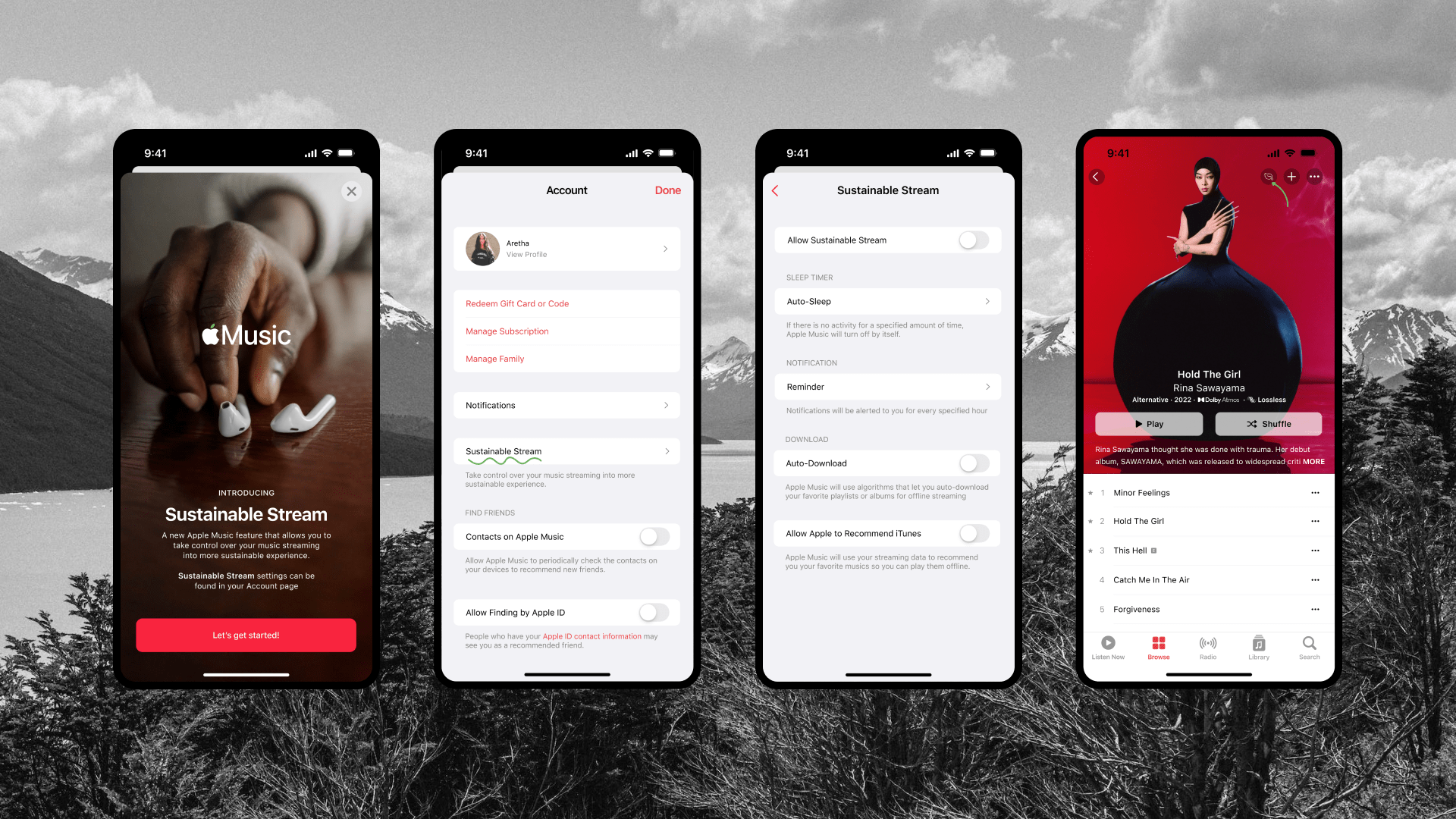
Sustainable Stream Feature for Apple Music
‍
‍
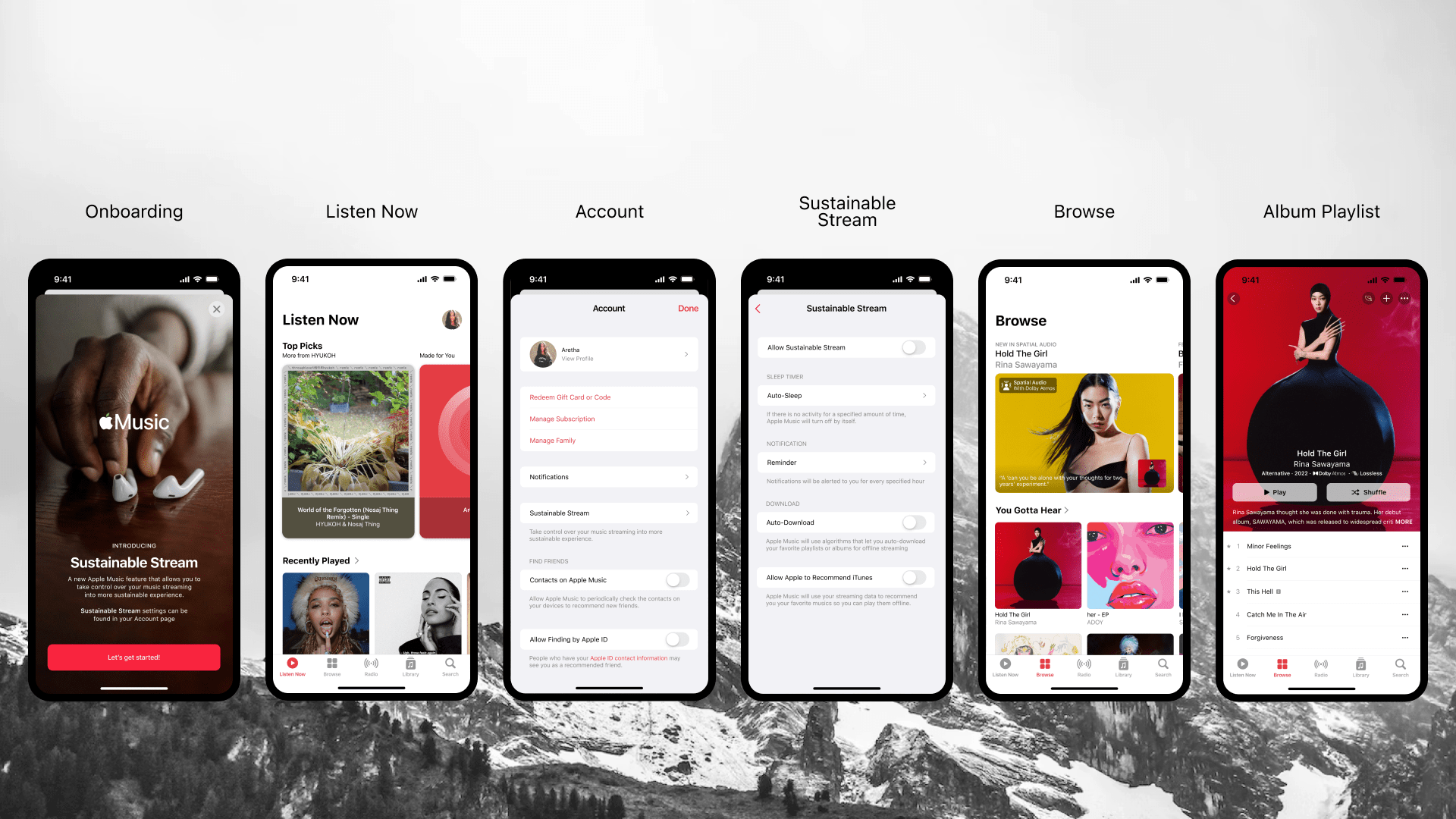
1 Onboarding to introduction for Sustainable Stream first thing when users open Apple Music with feature description & instructions how to use the feature.
2 The setting is implemented right in the existing Account screen so users would be familiar with the whereabout.
3 Auto-sleep feature lets Apple Music to close automatically after a specified period of time.
4 Reminder feature lets Apple Music users known how long have they used the app through notifications.
5 Auto Download feature lets users download preferred musics for offline stream.
6 Last settings in the feature is Auto-Recommend iTunes based on the algorithms of most replayed songs or new releases for offline stream while helping artists and Apple to generate revenues.
7 Sustainable Stream Icon is added in the album playlist for easy on or off.

The Process

First of all, I had to understand certain things: who are the users and what their needs are, how the product would position itself on the market with other companies and solutions. To find this out, I decided to follow IDEO’s Human-Centered Design to make sure that my design decisions were supported by user research and feedback.

Empathise

  • Sec. Research
  • Competitive Res.
  • User Interview

Define

  • Persona
  • Empathy Map
  • Storyboard
  • Prob. Statement
  • User Flow

Ideate

  • Information Architecture

Prototype

  • High Fidelity Prototype

Test

  • Usability Testing
  • Affinity Map
  • Final Prototype
  • Afterwords

Empathise01

Understanding the market and users

Secondary Research

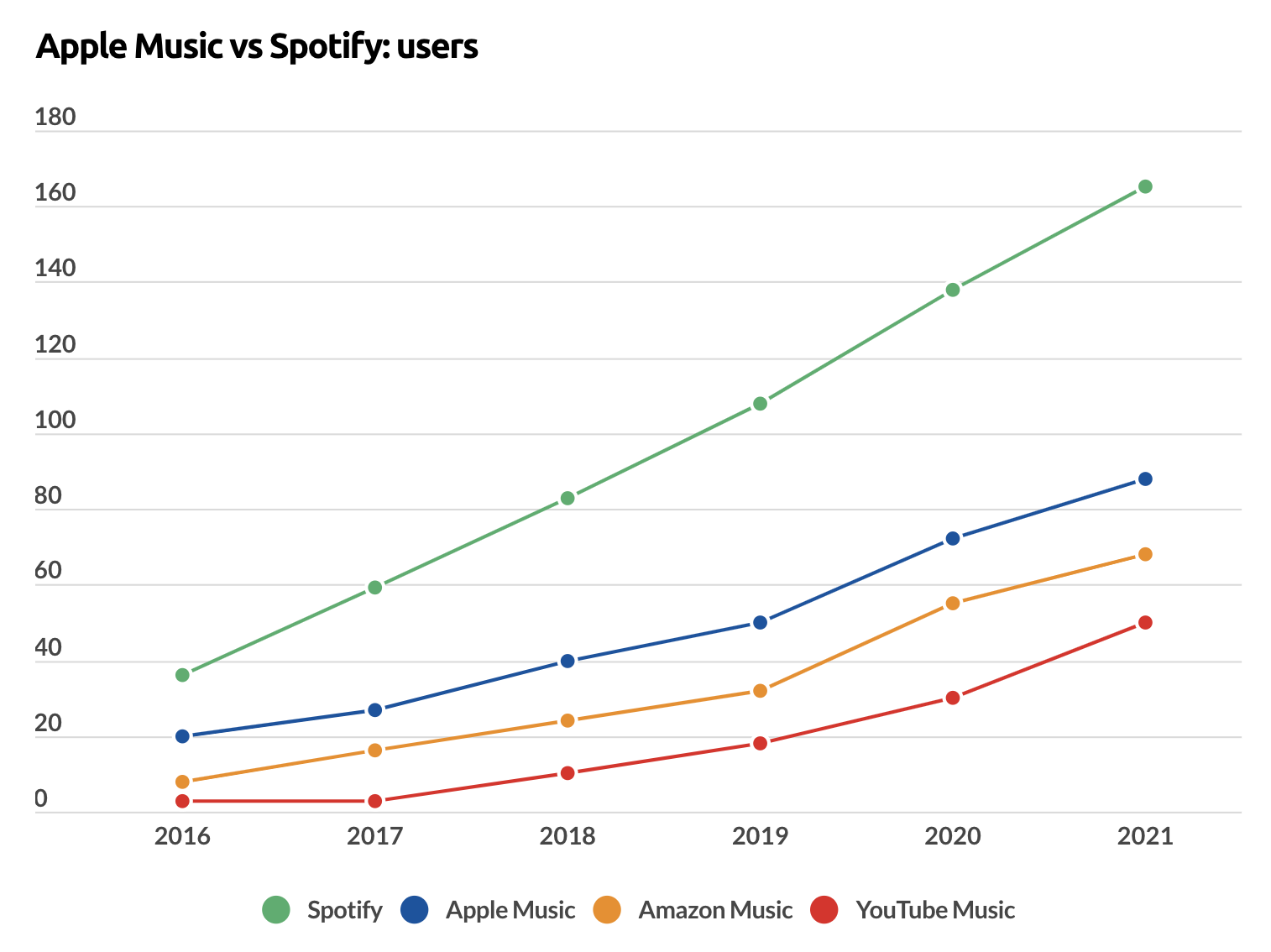
Apple Music vs Spotify users chart from 2016 to 2021

1 In the first half of 2021, there were 82.1 million paid music streaming subscribers in the United States. (source: Statista)
2 Like revenues, subscriber numbers have been creeping up year by year, rising from 7.9 million in the first six months of 2014 to 82.1 million seven years later (source: Statista)
3 62% of U.S. adults subscribe to streaming services with the average American subscribing to an average of 3.4 services (source: Vindicia)

Just from these statistics, it is clear that streaming service apps such as Apple Music is worth focusing on and even small changes would be very impactful to the environment.

Competitor Research

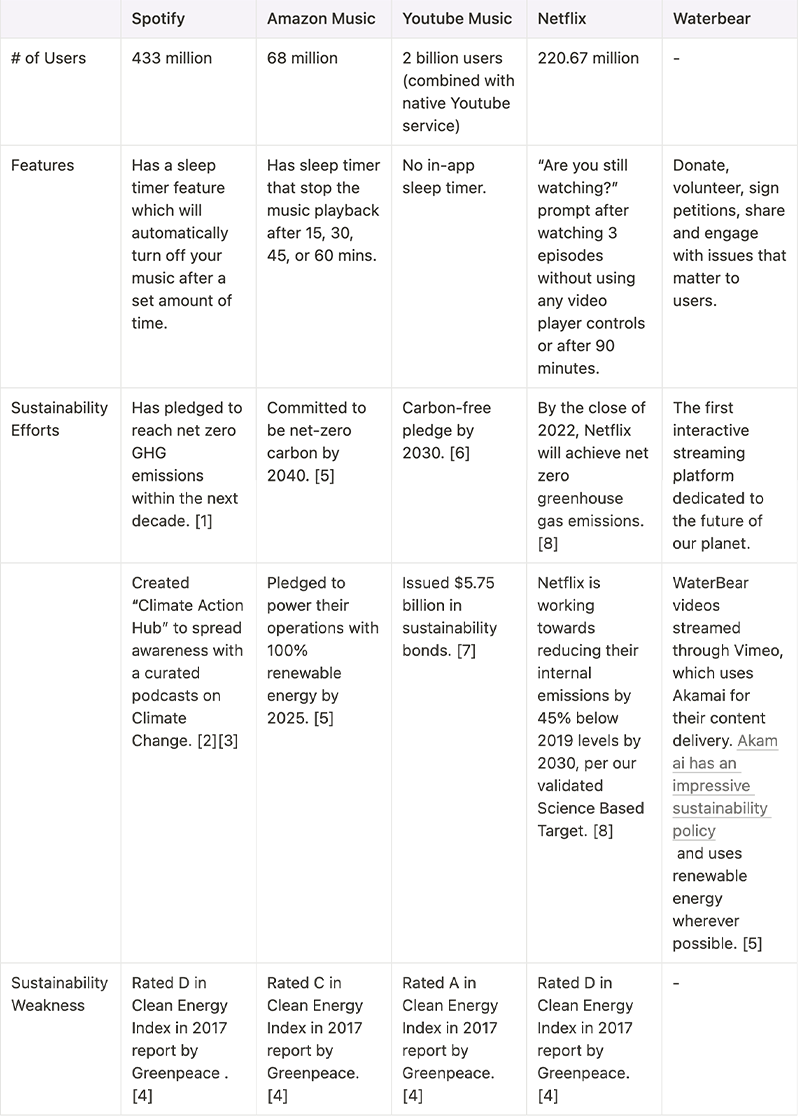
In order to better understand music streaming platform market and their effort in reducing carbon footprints or lack thereof, I researched some of the top streaming competitors. As I conducted the research, I made sure to write down the focused features, their sustainability approach and weakness of each of the competitors.
‍

Competitor Research between Spotify, Amazon Music, Youtube Music, Netflix & Waterbear

Sources:
[1] https://www.lifeatspotify.com/reports/Spotify-Equity-Impact-Report-2021.pdf
‍
[2] https://open.spotify.com/genre/0JQ5DAqbMKFHvI2V9Nh2Nj
‍
[3] https://newsroom.spotify.com/2022-04-22/this-earth-day-spotify-is-handing-the-mic-to-young-climate-activists/
‍
[4] https://www.greenpeace.de/sites/default/files/publications/20170110_greenpeace_clicking_clean.pdf
‍
[5] https://www.aboutamazon.com/planet
‍
[6] https://www.youtube.com/howyoutubeworks/progress-impact/sustainability/
‍
[7] https://blog.google/alphabet/alphabet-issues-sustainability-bonds-support-environmental-and-social-initiatives/
‍
[8] https://about.netflix.com/en/sustainability
‍
[9] https://www.waterbear.com/-/sustainability-ethos

Survey & Interviews

Once I had the competitive research of the focused features, their sustainability approach and weakness of each of the competitors done, I decided to conduct some user interviews to do better understand the needs and pain points of Apple Music users.

I interviewed a total of 4 participants ranging between 22-35. Their professions ranged from college students, graphic designer to engineer. All participants have previous experience with using music streaming services including Apple Music.

Summary of interview findings:
‍
1 4/4 participants listen to music through their mobile phones and 3/4 use desktop version while working or studying.
2 3/4 participants spent more than 4 hours listening to music everyday
3 2/4 participants spent more than 1 hours actively listen to music (put the music not just in the background, and are not doing anything else at the same time that takes away their focus)
4 2/4 participants are well aware of the environmental impact of streaming services
5 4/4 participants agree that music streaming platforms should be more sustainable

Here are some pain points that were brought up during the interviews:

1 “Apple Music doesn’t even has basic functionality like sleep timer so there are times when music would be playing all night while I was sleeping”
2 “I have heard about environmental impact with streaming but I don’t think personal impact would make any differences if the effort won’t start with the streaming platform itself”
3 “I would probably feel less guilty if I can stream responsibly”
4 “I would like to learn more about sustainability, if I could stream responsibly and sustainably its a win-win situation”

Define02

Concreting the problems

persona

With the research conducted and insights gained from the participants and other resources, I came up with a user persona that reflects the needs and pain points that were brought up during my interview research.
‍
Personas provide us with a precise way of thinking and communicating about how groups of users behave, how they think, what they want to accomplish, and why. - About Face by Alan Cooper

User persona for Aretha

empathy map

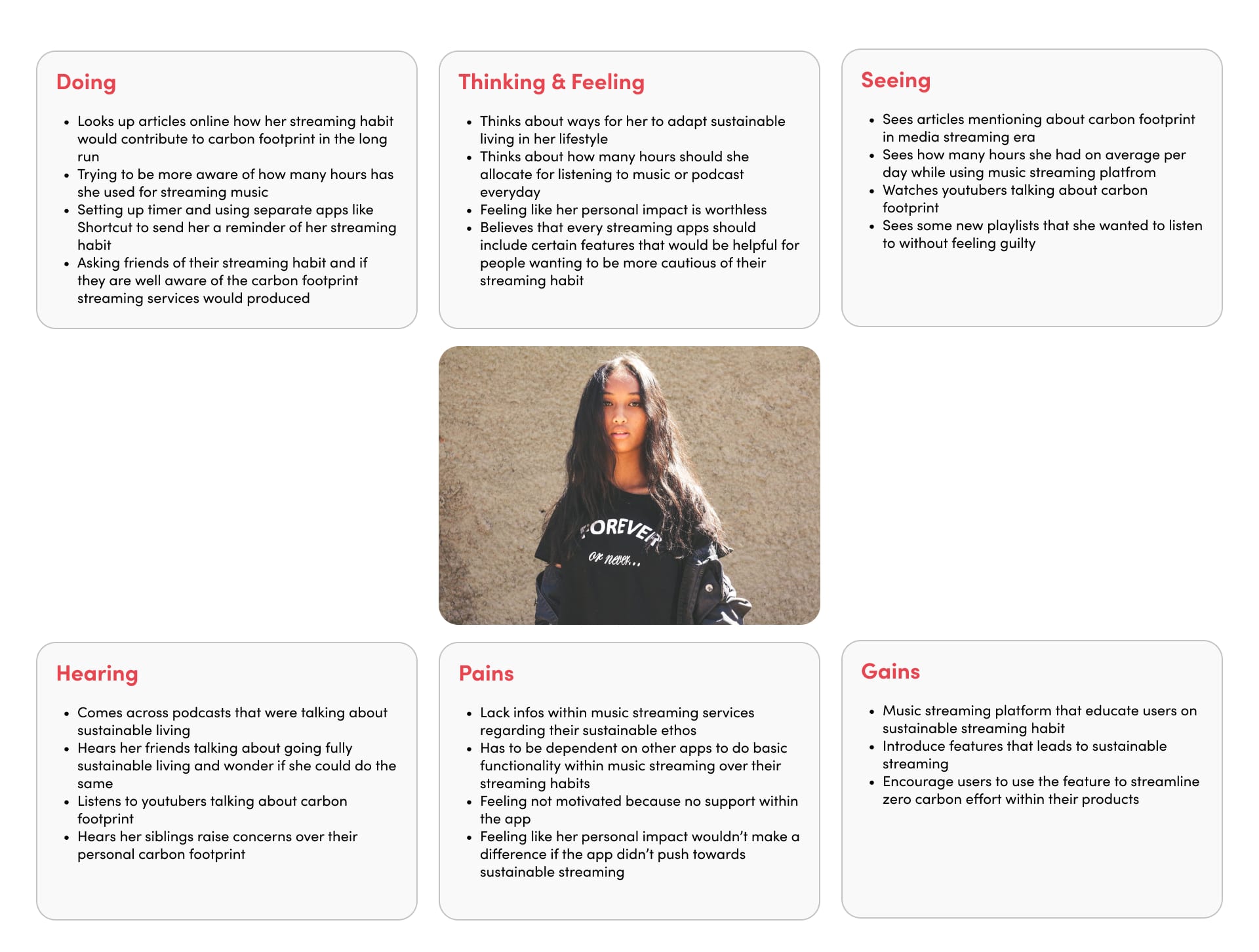
In order to bring the user persona to life, I imagined what some of Aretha’s thoughts, attitude, and actions might be as an avid user of music streaming. Here is the listing of them as it made it easier for me to identify the problem that needed to be solved.
‍‍

Empathy Map for Aretha

storyboard

Storyboard of Aretha listening to music while reading an article about carbon impact of streaming media

problem statement

By articulating different thoughts, feelings and actions based off the user persona, I was able to refine the question that was brought up earlier and identified a clean problem statement:

How can we make Apple Music more sustainable, transparent and informative so that users can make better-informed decisions about their streaming habit?

User Flow

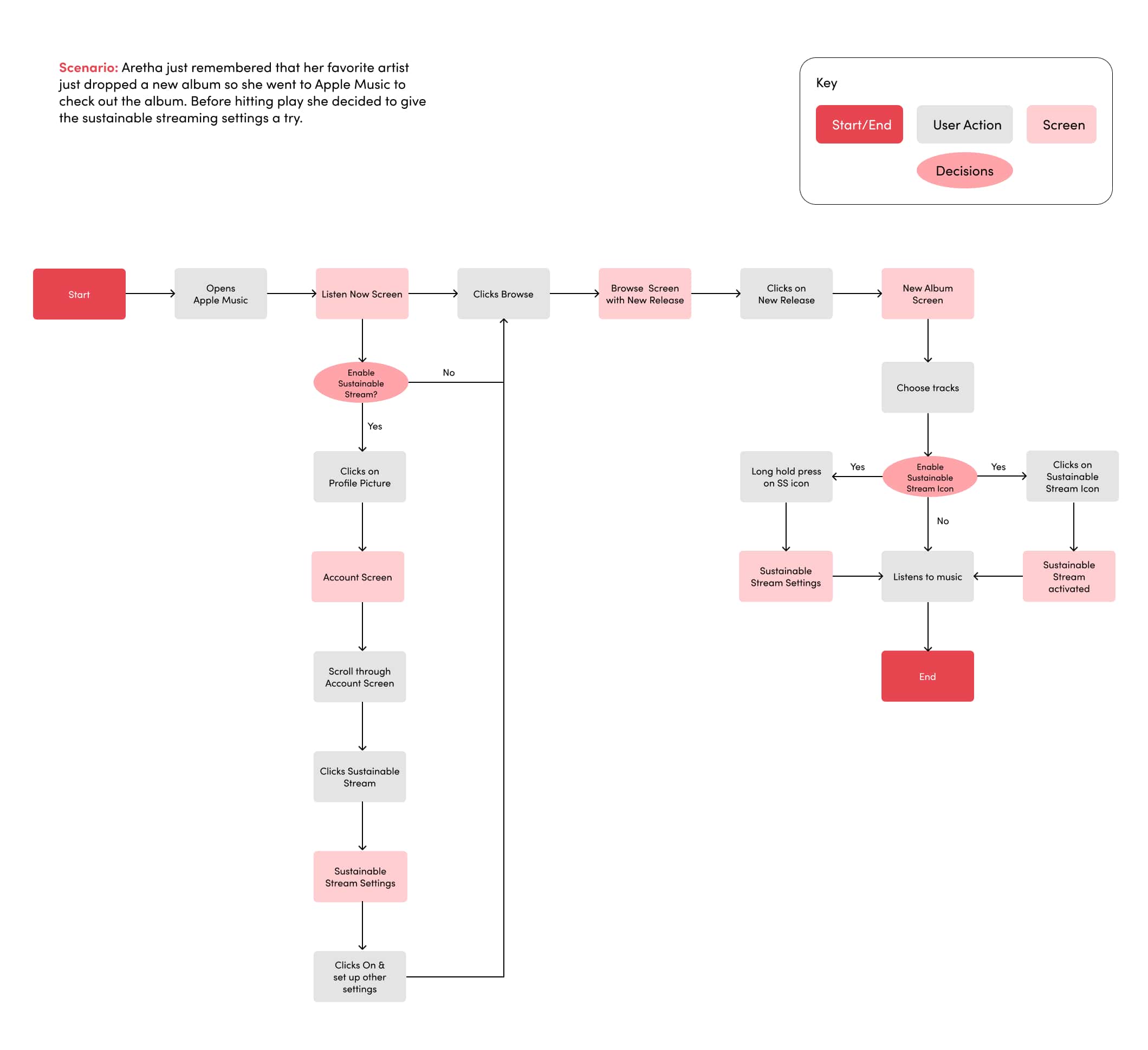
After I have figured out a clean clear user-centered problem statement, I came up with a user flow to visualise the different paths that the user persona, Aretha could take to start listening to music through Apple Music sustainably.

The scenario that I chose to focus on was that Aretha trying to check out the latest album from her favorite artist as suggested by Apple Music to her.

User Flow of Aretha using Apple Music with Sustainable Stream feature.

Ideate03

Generating solutions

Information Architecture

Now that I had an idea of the path that the user would take to look through the app to stream music and enabled the feature settings, I created the information architecture to see how the new features were going to be implemented into the existing app.

Information Architecture

Prototype04

Building representation of ideas and refining

High-Fidelity Wireframes

Due to time constraints, I jumped right into creating high-fidelity wireframes on Figma. The screens that I designed are the Onboarding, Listen Now, Browse, Sustainable Stream Settings, and Playlist Screen.

Test05

Collecting information about usability

usability testing

After the initial prototype is made, I tested it on 4 users. I made a usability test plan where I outlined the test objectives, methods, KPIs and defining the core tasks for users to complete. The usability plan also included a script for the remote unmoderated sessions.

Based on the findings, the prototype was a success. The participants were able to understand the added feature and the functionality and able to complete the tasks without any major issues. However, it is important to note that the usablity testing also helped me identify areas of improvement which I later worked on in the revisions.

Affinity Map

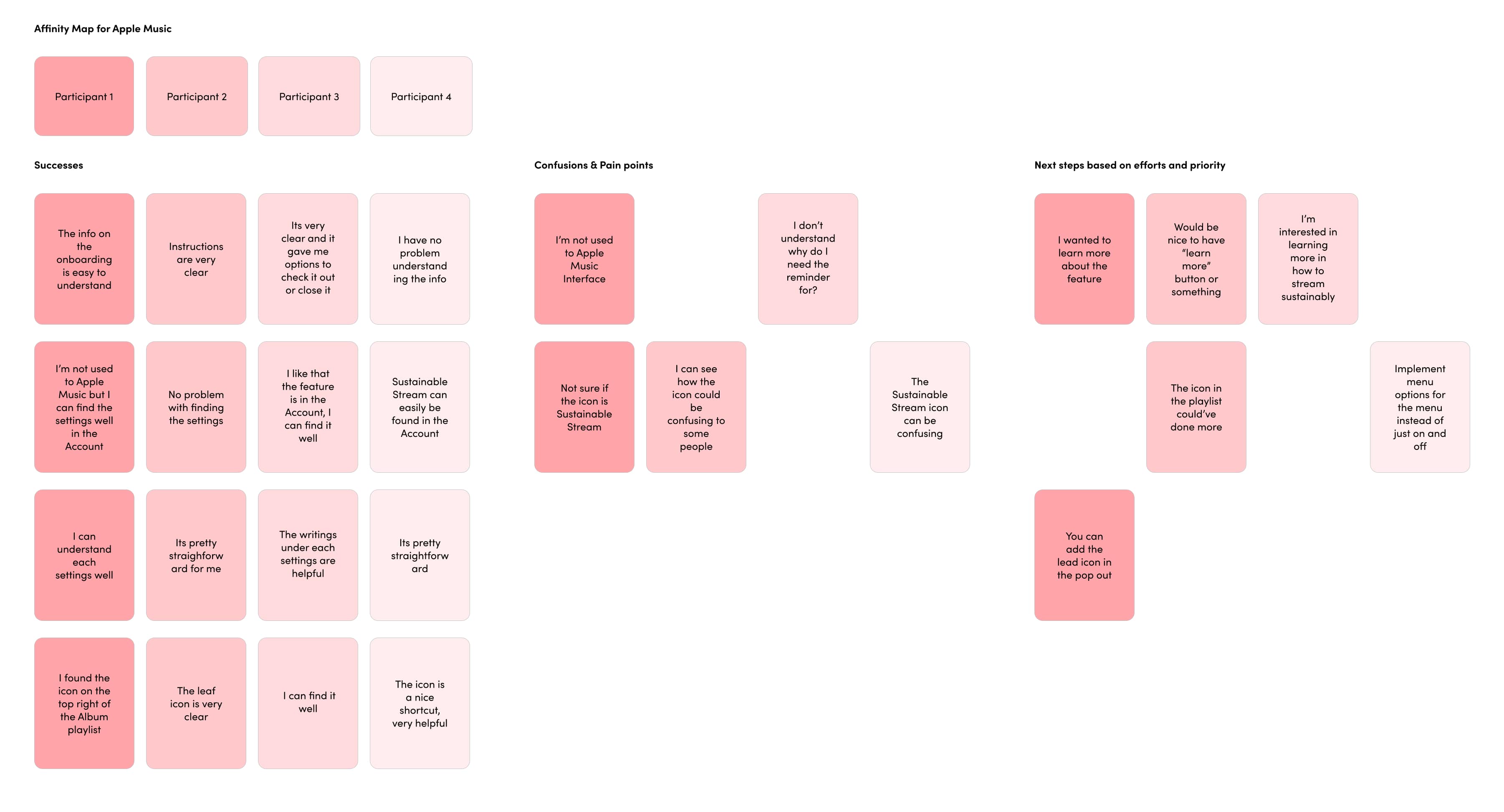
After Usability Testing, I visualise the key points that the participants brought up during the testing session into an affinity map.

Affinity map from usability testing interviews

Here are the most important changes that needed to be made based on the feedback provided by the participants during usability testing:

1 To include "learn more" in the Sustainable Stream onboarding pop out so users can learn more about the feature if they are interested in learning more about the feature.
2 Make the leaf icon for Sustainable Stream in the Album playlist more clear and apparent.

Final prototype

With all the issues and pain points been revised, I created the final prototype that provides all the information necessary for users to use this feature seamlessly without any friction.

View Final Prototype

Afterword

Revisiting the Problem Statement

How can we make Apple Music more sustainable, transparent and informative so that users can make better-informed decisions about their streaming habit?
In this case, the problem is solved by using the most apparent solution to sustainability which is "reduce" while trying to not to hurt the business side of it by encouraging users to support their favourite artists with iTunes sales and download for offline streaming which encourages subscription.

Next Steps


For this particular project, I focused on introducing better streaming practice for more sustainable streaming experience. If I could developed this feature even more, I would have gone further with educating thus spreading awareness among users so it could encourage feature use.

Challenge Faced


1 Since Apple Music is an already existing app, I had to make sure that the new features that I was adding to the app were consistent with the other features and overall look of the app.
2 Before conducting user interviews, I had an idea of ​​where I wanted to go with the project. I had to be very careful with the wording of the interview questions so as not to mislead the participants.

Learning

1 Since this is my only second case study, I had learned a lot especially this is my first time doing a project for an existing product with well established branding and look. There are a lot of technical constraints to consider, but it was also very exciting. While basically copying Apple Music UI components, I had learned a lot about proper UI practice that Apple implemented in their products.
2 I learned to not be to dependent on the scripts while doing user interviews or affinity test, some of the best interviews I had with participants were the product of going off-script and letting users to be comfortable in letting out their thoughts.
3 While doing this project research, I'm grateful to be able to learn more about sustainability and ways to reduce personal carbon footprint. I learned that all of us can contribute to fighting global warming by making climate-friendly choices in our daily lives.


Thank you for your time :)

Let's discover

Next work

limiedesign@gmail.com

© 2022 Made by Limmy with  💖 in Kuala Lumpur, Malaysia.

Last updated August 2022.